
UN Resolution Declares Slave Trade 'Gravest Crime Against Humanity'
Don’t look at who voted to call the slave trade ‘the gravest crime’, look at who didn’t | Kenneth Mohammed
 The Guardian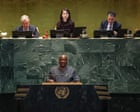
Image: The Guardian
On March 25, the UN General Assembly adopted a resolution led by Ghana, declaring the trafficking and enslavement of Africans as 'the gravest crime against humanity.' While 123 nations supported it, notable abstentions included the UK and EU countries, highlighting a divide in acknowledging historical injustices and the need for reparations.
- 01The UN resolution passed with 123 votes, declaring the slave trade as 'the gravest crime against humanity.'
- 02The US, Israel, and Argentina voted against the resolution, while the UK and EU countries abstained.
- 03Ghana's President John Dramani Mahama emphasized the resolution as a pathway to healing and reparative justice.
- 04Opponents framed reparations as a financial burden rather than a moral obligation.
- 05The resolution is seen as a critical step in addressing the historical impacts of slavery and promoting reparative justice.
Advertisement
In-Article Ad
On March 25, 2023, the UN General Assembly adopted a Ghana-led resolution that recognized the trafficking and enslavement of Africans as 'the gravest crime against humanity,' passing with 123 votes in favor, while only three countries voted against it: the United States, Israel, and Argentina. The resolution urges formal apologies, reparatory justice, and the return of looted cultural property. Notably, the UK and all EU member states abstained from the vote, reflecting a reluctance in the West to confront the historical implications of transatlantic slavery. Ghana's President John Dramani Mahama described the resolution as a crucial step towards healing and reparative justice, emphasizing the need to acknowledge the enduring consequences of slavery. Critics from the UK and EU expressed concerns that the resolution could create a 'hierarchy of historical atrocities,' arguing that it might undermine other historical injustices. However, advocates assert that recognizing slavery's impact is essential for addressing ongoing inequalities and injustices. The resolution is viewed as a significant political and moral milestone, shifting the discourse on reparations from the margins to the center of international dialogue, and prompting further discussions on historical accountability and justice.
Advertisement
In-Article Ad
This resolution could lead to increased demands for reparations and formal apologies from former colonial powers, affecting diplomatic relations and public discourse on historical injustices.
Advertisement
In-Article Ad
Reader Poll
Do you believe former colonial powers should offer reparations for historical injustices?
Connecting to poll...
More about United Nations
Iran's Proposed Toll on Ships in Strait of Hormuz Raises Legal and Strategic Concerns
News 18 • Apr 8, 2026
US, Iran, and Israel Agree to Two-Week Ceasefire Amid Ongoing Conflict
The Economic Times • Apr 8, 2026

US-Iran Ceasefire Agreement Opens Door for Diplomacy Amid Tensions
The Economic Times • Apr 8, 2026
Read the original article
Visit the source for the complete story.