

Ancient Fossil Confirms Egg-Laying in Mammal Ancestors
Mammal ancestors laid eggs, and this 250-million-year-old fossil finally proves it
 sciencedaily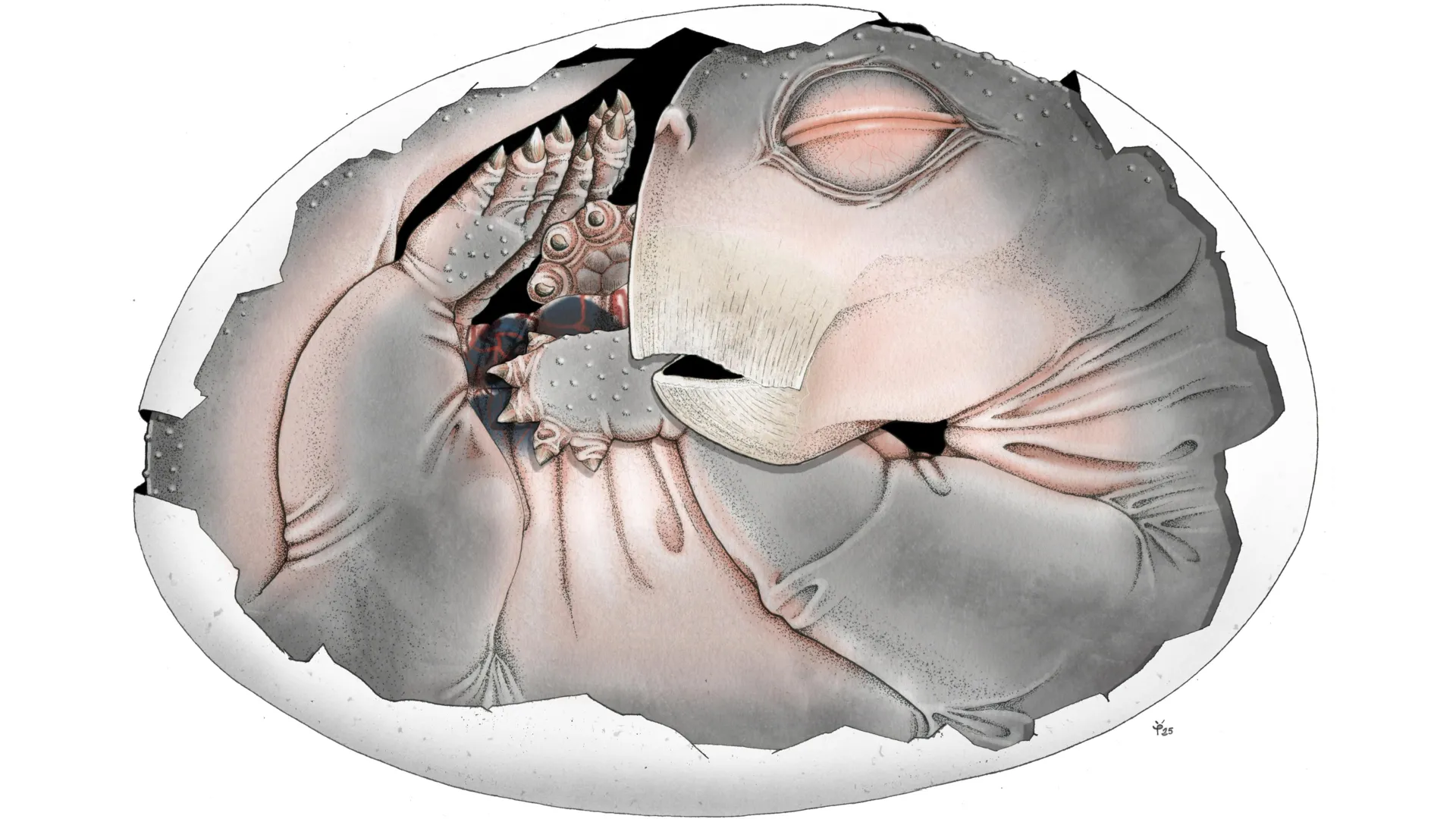
Image: sciencedaily
A 250-million-year-old fossil egg containing a Lystrosaurus embryo has confirmed that mammal ancestors laid eggs, resolving a long-standing scientific question. This discovery sheds light on how these ancient creatures thrived after the End-Permian Mass Extinction, highlighting their reproductive strategies and adaptability in harsh environments.
- 01The fossil egg is the first confirmed evidence of egg-laying in mammal ancestors.
- 02Lystrosaurus, a dominant species after the End-Permian Mass Extinction, produced large, soft-shelled eggs.
- 03Advanced imaging technology revealed crucial details about the embryo's development.
- 04The findings suggest Lystrosaurus hatchlings were precocial, capable of self-feeding shortly after birth.
- 05This discovery provides insights into survival strategies during extreme environmental changes.
Advertisement
In-Article Ad
A groundbreaking discovery of a 250-million-year-old fossil egg containing a curled-up Lystrosaurus embryo has confirmed that mammal ancestors indeed laid eggs. This finding addresses a long-standing question in evolutionary biology and reveals how Lystrosaurus thrived after the End-Permian Mass Extinction, which devastated life on Earth around 252 million years ago. The fossil, identified by an international research team led by Professor Julien Benoit from the University of the Witwatersrand in South Africa, showcases the unique reproductive strategies of Lystrosaurus, which likely laid large, soft-shelled eggs rich in nutrients. Such eggs are rare, as they typically decay before fossilization, unlike the hard-shelled eggs of dinosaurs.
Using advanced synchrotron x-ray CT scanning, researchers were able to examine the fossil in detail, confirming that the embryo was at a pre-hatching stage and could not yet feed itself. This indicates that Lystrosaurus hatchlings were precocial, allowing them to survive independently shortly after birth. The study suggests that these reproductive strategies were crucial for survival in the harsh conditions following the extinction event. This research not only enhances our understanding of early mammal evolution but also offers valuable insights into resilience and adaptability in the face of climate change and ecological crises today.
Advertisement
In-Article Ad
This discovery provides insights into the reproductive strategies that allowed Lystrosaurus to thrive in extreme conditions, which can inform current understanding of species resilience amid climate change.
Advertisement
In-Article Ad
Reader Poll
How important is it to study ancient species for insights into modern biodiversity?
Connecting to poll...
Read the original article
Visit the source for the complete story.