



Insights from James Webb Telescope on Exoplanet HATS-75 b
Astronomers Study Exoplanet HATS-75 b Using James Webb Telescope. Here's What They Found
 Ndtv
Ndtv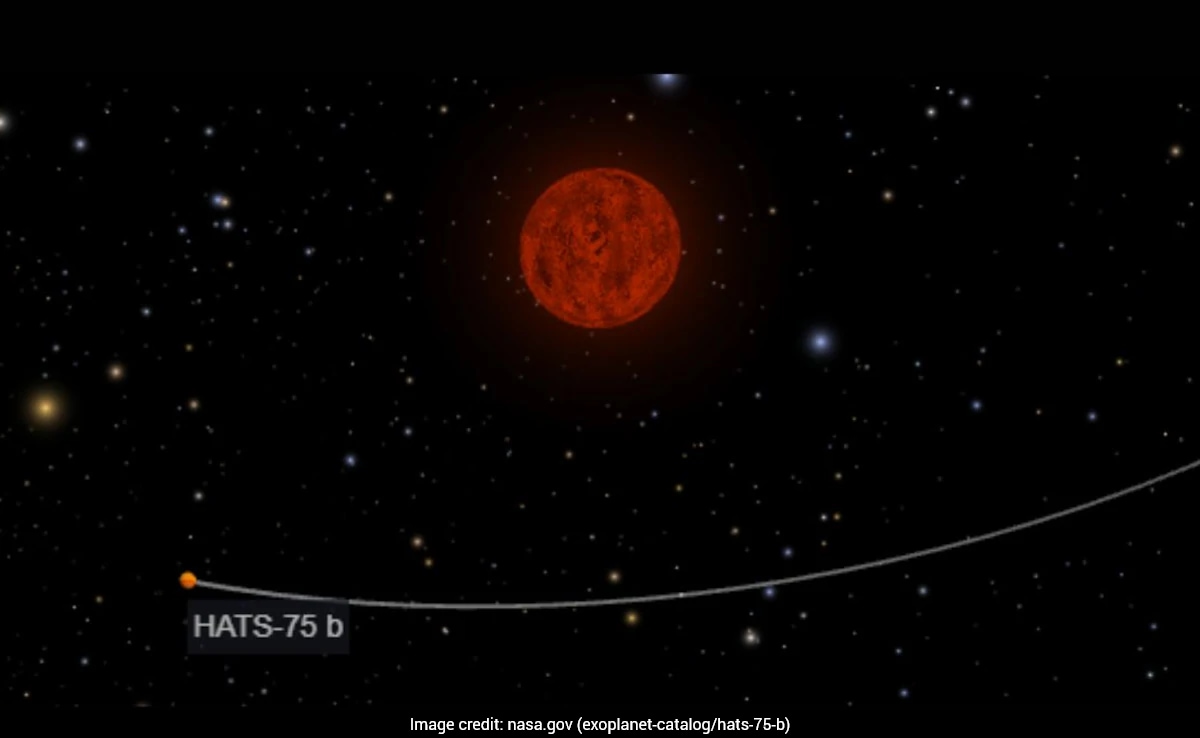
Image: Ndtv
Astronomers from Johns Hopkins University utilized the James Webb Space Telescope to study HATS-75 b, a giant exoplanet located 637 light-years away. Their findings reveal complexities in its atmospheric composition, highlighting the influence of stellar characteristics on data interpretation.
- 01HATS-75 b is a giant exoplanet discovered in 2021, located 637 light-years from Earth.
- 02The study focused on the chemical composition of HATS-75 b's atmosphere.
- 03Observations indicated potential contamination in the planet's atmospheric data due to stellar features.
- 04The research underscores the challenges in interpreting transmission spectra from low-mass star systems.
- 05HATS-75 b is part of a rare group of giant planets around M-dwarfs studied with the James Webb Space Telescope.
Advertisement
In-Article Ad
Astronomers from Johns Hopkins University (JHU) have conducted a detailed analysis of HATS-75 b, a giant exoplanet located approximately 637 light-years from Earth, using the James Webb Space Telescope (JWST). Discovered in 2021 through the Automated Telescope Network-South and NASA's Transiting Exoplanet Survey Satellite, HATS-75 b is part of a unique category of exoplanets orbiting M-dwarf stars. The team, led by Reza Ashtari, focused on the planet's atmospheric composition, revealing that its spectra showed a greater transit depth at shorter wavelengths. This suggests the presence of hazes or contamination from stellar features, complicating the interpretation of the atmospheric data. The findings emphasize the importance of considering stellar characteristics when analyzing transmission spectra, as contamination from unocculted starspots and faculae may affect results. This research highlights the challenges faced in studying the atmospheres of planets around low-mass stars and contributes to our understanding of these uncommon celestial bodies.
Advertisement
In-Article Ad
Advertisement
In-Article Ad
Reader Poll
How important do you think studying exoplanets is for understanding our universe?
Connecting to poll...
More about Johns Hopkins University

Discovery of Primitive Star Offers Insights into the Early Universe
Johns Hopkins University • Apr 16, 2026

Johns Hopkins Expert Highlights Malaria's Rising Threat Despite Vaccination Efforts
Ndtv • Apr 9, 2026

Johns Hopkins University Celebrates 150 Years with Sesquicentennial Awards
Johns Hopkins University • Apr 8, 2026
Read the original article
Visit the source for the complete story.