




Peking University AI Framework Solves Decade-Old Mathematical Conjecture
Solved in 80 hours: Peking University’s new AI framework cracks decade-old math without human help
 The Indian Express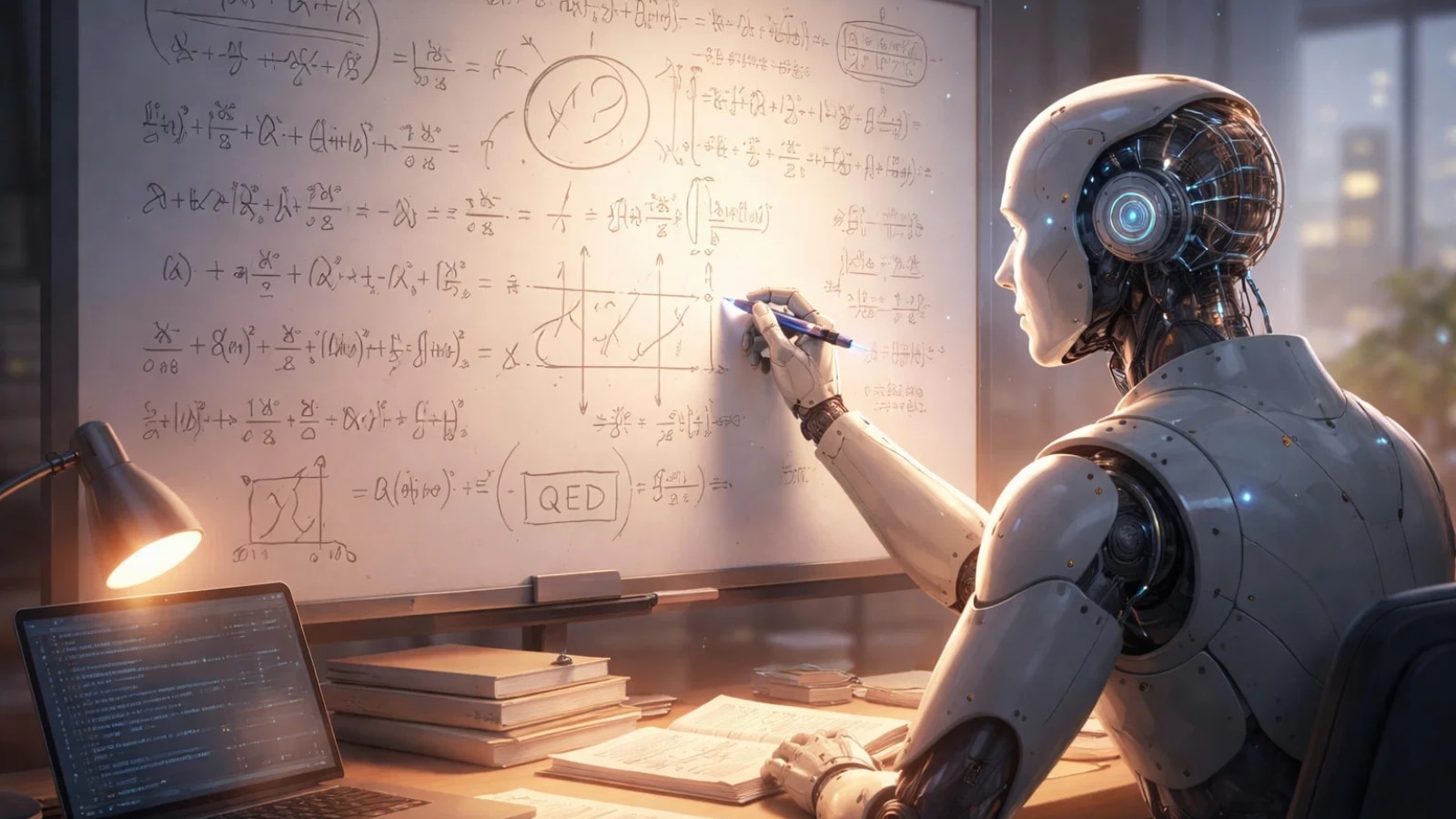
Image: The Indian Express
A research team from Peking University has developed an AI framework that independently solved a decade-old mathematical conjecture proposed by the late Dan Anderson from the University of Iowa. The breakthrough, achieved in approximately 80 hours, marks a significant advancement in automating mathematical research.
- 01Peking University's AI solved a conjecture in commutative algebra first proposed in 2014.
- 02The AI framework completed the task in about 80 hours, a process that typically requires extensive human collaboration.
- 03The system combines a reasoning engine (Rethlas) and a mathematical search tool (Matlas) to mimic human problem-solving.
- 04This achievement could change the future of mathematical research by automating complex tasks.
- 05Unlike traditional proof assistants, this AI framework operates with minimal human input.
Advertisement
In-Article Ad
A team from Peking University in China has successfully utilized artificial intelligence to solve a long-standing mathematical problem that had remained unresolved since its proposal by Dan Anderson, a professor at the University of Iowa, in 2014. The conjecture was addressed using a novel AI framework that includes a reasoning engine named Rethlas and a mathematical search tool called Matlas, which together simulate the problem-solving approaches of human mathematicians. The entire process took approximately 80 hours, significantly less time than would typically be required for human collaboration. This dual-system approach allows for the generation of potential solutions and their conversion into a formal proof format compatible with Lean 4, an interactive theorem prover. The researchers believe this development could revolutionize mathematical research by automating time-consuming tasks, allowing mathematicians to concentrate on higher-level thinking. This achievement stands out in a field where most existing AI tools still depend on human oversight, marking a significant milestone in the growing intersection of AI and mathematics.
Advertisement
In-Article Ad
Advertisement
In-Article Ad
Reader Poll
Do you think AI will significantly change mathematical research in the future?
Connecting to poll...
Read the original article
Visit the source for the complete story.